
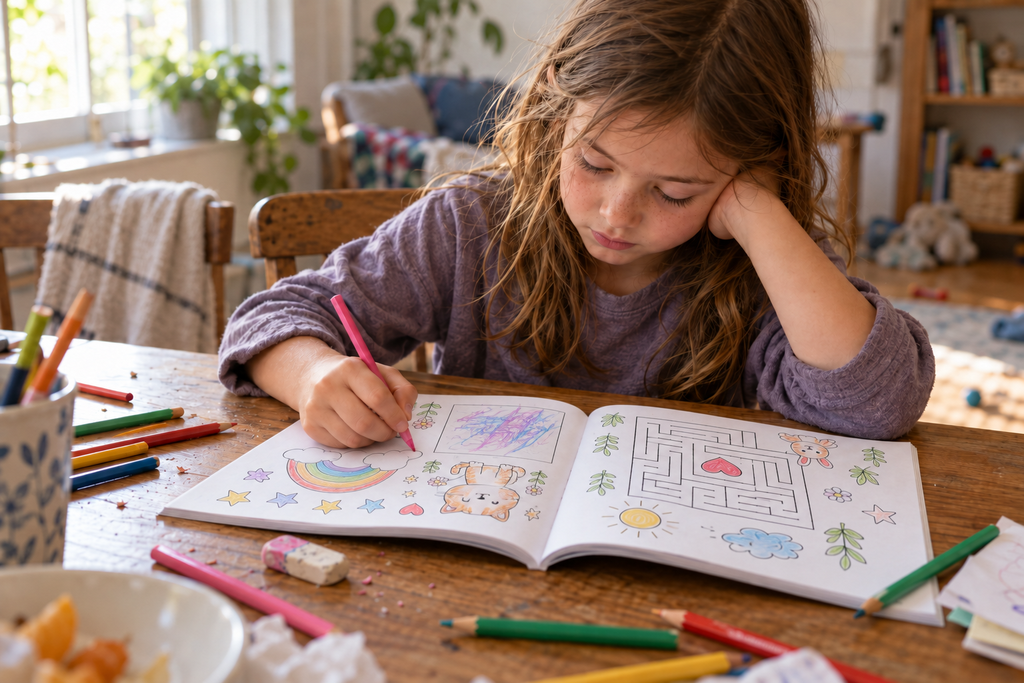
Activity books invite children to do more than turn the pages. They can color, draw, solve puzzles, follow instructions, practice new skills, and become part of the book themselves.
They are useful for parents looking for screen-free activities, teachers creating supplementary materials, therapists developing exercises, and authors who want to combine stories with play or learning. With BookBildr, you can design the pages yourself and turn your project into a professionally bound printed book.
What kind of activity book can you create?
An activity book does not have to be a collection of generic coloring pages. It can be built around a particular subject, story, or educational goal.
You might create:
- a coloring and drawing book;
- a puzzle or maze book;
- a literacy or early-learning workbook;
- a math or language-practice book;
- a nature, travel, or museum activity book;
- a journal or guided reflection book;
- a book of games and creative prompts;
- a story with activities between the chapters;
- a book for use in classrooms, therapy sessions, or community programs.
The strongest activity books have a clear audience and purpose. Before you begin, decide who will use the book, what they should be able to do independently, and which activities may require help from an adult.
Choose a practical page size
For most activity books, we recommend either:
- A4 portrait for European and international projects; or
- US Letter portrait for books intended mainly for the United States.
These larger portrait formats provide enough room for children to write, color, and draw comfortably. They also work well for worksheets, puzzles, and classroom activities.
Small picture-book formats may look attractive, but they can leave too little space for handwriting or detailed coloring. Landscape pages can also be less convenient to hold and use, particularly when the book has perfect binding.
Create at least 32 pages
A printed activity book should contain 32 pages or more. This gives the book enough substance for perfect binding and allows you to develop the subject properly rather than presenting a very small assortment of unrelated exercises.
Remember that every printed page counts, including:
- the title and copyright pages;
- instructions for parents or teachers;
- activity pages;
- answer pages;
- certificates or completion pages;
- intentionally blank pages.
When planning the book, consider how the pages will appear as facing spreads. Avoid placing an activity across the center unless it can still be completed comfortably near the binding.
Use BookBildr’s images—or bring your own
BookBildr gives you several ways to add illustrations to your activity book. You can:
- choose images from BookBildr’s stock-image collection;
- upload your own drawings, photographs, or finished activity pages;
- generate new images for your project;
- combine these approaches within the same book.
For example, you could upload your own educational diagrams, use stock images for decorative elements, and generate supporting illustrations for individual activities.
Whatever source you use, make sure you have the right to reproduce the images commercially. Avoid copyrighted characters, logos, and artwork belonging to other creators unless you have explicit permission.
Generated images should also be checked carefully. Look for malformed hands or objects, inconsistent characters, incorrect details, and elements that may confuse a child. An image can be attractive while still being unsuitable for an educational activity.
Design pages children can actually use
A good activity page should make its purpose immediately clear. Children should not have to study a crowded layout before understanding what to do.
Use:
- large, readable type;
- short instructions;
- generous writing and drawing spaces;
- strong contrast;
- clear visual hierarchy;
- age-appropriate vocabulary;
- consistent symbols and directions;
- margins that keep important content away from the page edges and binding.
Test every puzzle and activity before printing. Ask someone unfamiliar with the project to complete the pages without additional explanation. This can reveal missing instructions, ambiguous questions, and activities that are too difficult or too small to use comfortably.
If children will write on both sides of a sheet, also consider how dense artwork or heavy coloring may affect the reverse side.
Choose uncoated paper
At checkout, select uncoated paper for any book intended for writing, drawing, or coloring.
This is essential. Pencils, crayons, and many pens work much better on an uncoated surface. Glossy paper may look attractive in an ordinary picture book, but it can be slippery, reflective, and difficult to write on.
Uncoated paper also makes an activity book feel more like a practical workbook—something the child is invited to use rather than merely look at.
Black and white or full color?
BookBildr activity books can be printed with either:
- a black-and-white interior; or
- a full-color interior.
Black and white is a natural choice for coloring books, line drawings, writing exercises, and worksheets. It also keeps the printing price low.
Importantly, choosing a black-and-white interior does not mean that the entire book must be monochrome. The cover can still be printed in full color, giving the book an attractive, professional appearance while keeping the interior economical.
For projects that need colored instructions, photographs, or illustrations, BookBildr’s standard color printing option can make a full-color activity book surprisingly affordable. Premium color is not necessary for many activity books: standard color is often perfectly suitable for children’s illustrations, diagrams, puzzles, and educational content.
The right choice depends on how the book will be used. If color is part of the activity or necessary for understanding the instructions, choose color. If children will supply the color themselves, a black-and-white interior is usually the more practical option.
Perfect binding creates a real book
Activity books produced through BookBildr use perfect binding, with the pages securely attached inside a full-color paperback cover.
This gives the finished project the appearance of a professionally published book rather than a stack of photocopied worksheets. It is suitable for individual orders, gifts, classroom materials, and books intended for wider sale.
Because perfect-bound books do not lie completely flat, leave comfortable inner margins and avoid placing small writing areas too close to the spine. BookBildr’s margin guides will help you keep essential text and design elements in safe positions.
Always order a proof copy
Activities must be tested on paper, not only viewed on a screen.
Before ordering multiple copies or releasing the book for sale, order a proof and check:
- whether the instructions are easy to read;
- whether writing areas are large enough;
- whether puzzles work correctly;
- whether lines and pale details print clearly;
- whether anything is too close to the binding;
- whether the paper works with the intended pencils, crayons, or pens;
- whether blank pages appear where expected;
- whether the answer section matches the activities.
A proof copy is also the best way to test the book with a child in the intended age group. Watch where the child hesitates or asks for help: those moments may reveal improvements that are not obvious to the author.
Start creating your activity book
With BookBildr, you can combine text, activities, and illustrations in one online project, using stock images, your own uploads, generated images, or a mixture of all three.
For the most practical result, choose A4 or US Letter in portrait orientation, create at least 32 pages, select uncoated paper, and use either an affordable standard-color interior or economical black-and-white printing with a full-color cover.
The result is more than a collection of worksheets. It is a professionally bound book that children can explore, complete, and make their own.