
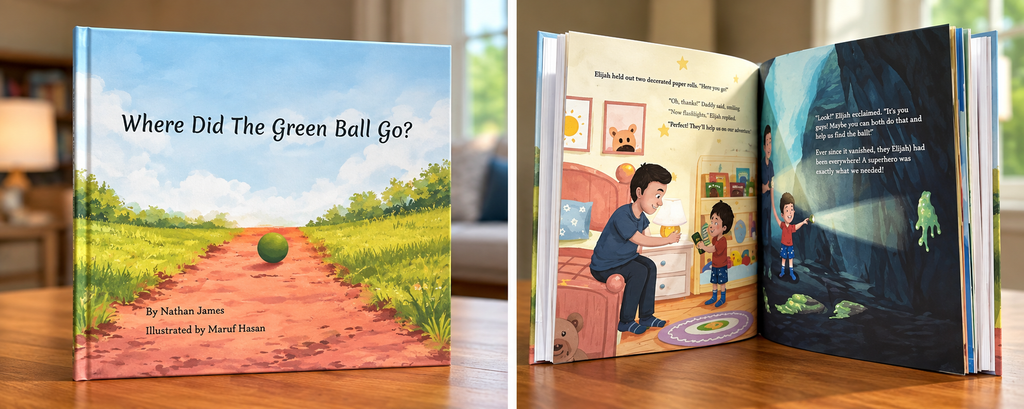
Some of the most meaningful children’s stories begin with something very small — a missing toy, a familiar room, or a few minutes of uninterrupted play between a parent and child. That’s exactly how Where Did The Green Ball Go? by Nathan James came to life.
The idea began when Nathan’s young son lost one of his toy balls. What started as a simple search around the house quickly became something much bigger. Together, father and son transformed ordinary rooms into unexplored places, following their imaginations wherever they led.
There was laughter, discovery, and the particular kind of excitement children can bring to even the most familiar surroundings. The green ball may have been the reason for the search, but before long, finding it was no longer the most important part.
For Nathan, the experience became a reminder of how powerful everyday moments of connection can be.
He wrote Where Did The Green Ball Go? to preserve that memory — not simply the game itself, but the feeling of being completely present with his son. Each room in the story offers a new adventure, not because the house has suddenly changed, but because father and son choose to see it differently together.
At its heart, the book is about imagination, but it is also about something quieter: attention.
For children, a parent joining a game can turn an ordinary afternoon into something memorable. A lost ball can become an expedition. A hallway can lead somewhere new. And a few minutes spent searching together can become part of the language of a family.
That idea becomes especially important toward the end of the story.
When the green ball is finally found, both father and son know where it is. But instead of allowing the adventure to end, the boy asks if they can search for it again the next day.
His father says yes.
That promise is the emotional heart of Where Did The Green Ball Go? The search is no longer really about the ball. It is about continuing to make time for one another — to play, imagine, explore, and stay connected even as life changes around them.
For Nathan, the book is also something deeply personal: a gift to his son and a keepsake of the time they shared when he was young.
Years from now, the little green ball may be long forgotten. But the book will remain as a reminder of those afternoons, the worlds they created together, and how much joy Nathan found in simply being there.
Nathan hopes Where Did The Green Ball Go? encourages other families to create those moments too. The adventure does not have to be elaborate. Sometimes all it takes is a misplaced toy, a little imagination, and the decision to stop whatever else is happening and play.
At BookBildr, we love seeing books that preserve moments like these — personal stories that begin inside one family and become something other parents and children can recognise in their own lives. Where Did The Green Ball Go? is a lovely reminder that childhood magic does not always live somewhere far away.
Sometimes, it is already waiting in the next room.
You can purchase copies of Where Did The Green Ball Go? on Amazon.