
Children do not suddenly lose their love of stories when they outgrow picture books. Yet many begin reading less for pleasure at around the age of nine.
The reasons are more complicated than the familiar complaint about shrinking attention spans. Children have schoolwork, activities, screens and increasingly limited uninterrupted time. Books also become longer and more text-heavy just as illustrations begin disappearing. A child who happily read a picture book may open a 300-page novel, see dense pages of uninterrupted text and decide that reading has become work.
Publishers are paying attention. Recent industry reporting describes growing interest in shorter middle-grade books, illustrated prose, comics-style panels, spot illustrations and stories designed to be read in manageable sections. Page counts below 200 are becoming more common, while some new series contain fewer than 150 pages per book. Publishers Weekly has identified shorter, more visual formats as one way publishers are trying to rebuild children’s reading confidence.
This is where the illustrated chapter book matters.
The missing step between picture books and novels
A picture book tells much of its story visually. The illustrations carry atmosphere, action, character and sometimes information that does not appear in the words at all.
A conventional novel asks the reader to imagine almost everything from text.
Chapter books occupy the broad and useful space between these formats. They introduce longer stories, more developed characters and independent reading without removing visual support all at once.
Depending on the intended reader, a chapter book might include:
- a full-page illustration at the beginning of every chapter
- small illustrations or decorative elements throughout the text
- maps, letters, diagrams or journal pages
- short chapters with clear stopping points
- generous margins and comfortable line spacing
- occasional comics-style panels or wordless sequences
- recurring characters across a series
Illustrations in these books are not simply decorations. They break up long passages, help children understand the setting and characters, and provide moments of rest and discovery. Finishing a chapter (and eventually an entire book) also gives a developing reader an important sense of achievement.
Shorter does not have to mean simpler, and visual does not have to mean childish. An illustrated chapter book can explore friendship, family, history, science, fantasy, anxiety, identity or any other subject appropriate for its readers. The format simply makes the story more approachable.
Why chapter-book series work
A series can make the transition to independent reading even easier.
Once children know the setting and characters, they do not have to enter an entirely unfamiliar world every time they begin a new book. They can return to a place they already understand and spend more time with characters they recognise.
For an author, a series also creates room for stories that do not need to be squeezed into one very long volume. Each book can offer a complete adventure while contributing to a larger world. Shorter instalments are less intimidating for readers and allow authors to publish new stories without waiting until an enormous manuscript is finished.
Consistency becomes especially important in a series. Character appearance, typography, trim size, chapter design and illustration style should make the books feel related. A recognisable cover system also helps readers and parents understand immediately that a new title belongs to a series they already know.
Cheryl Farnsworth and Spruce Hollow Tales
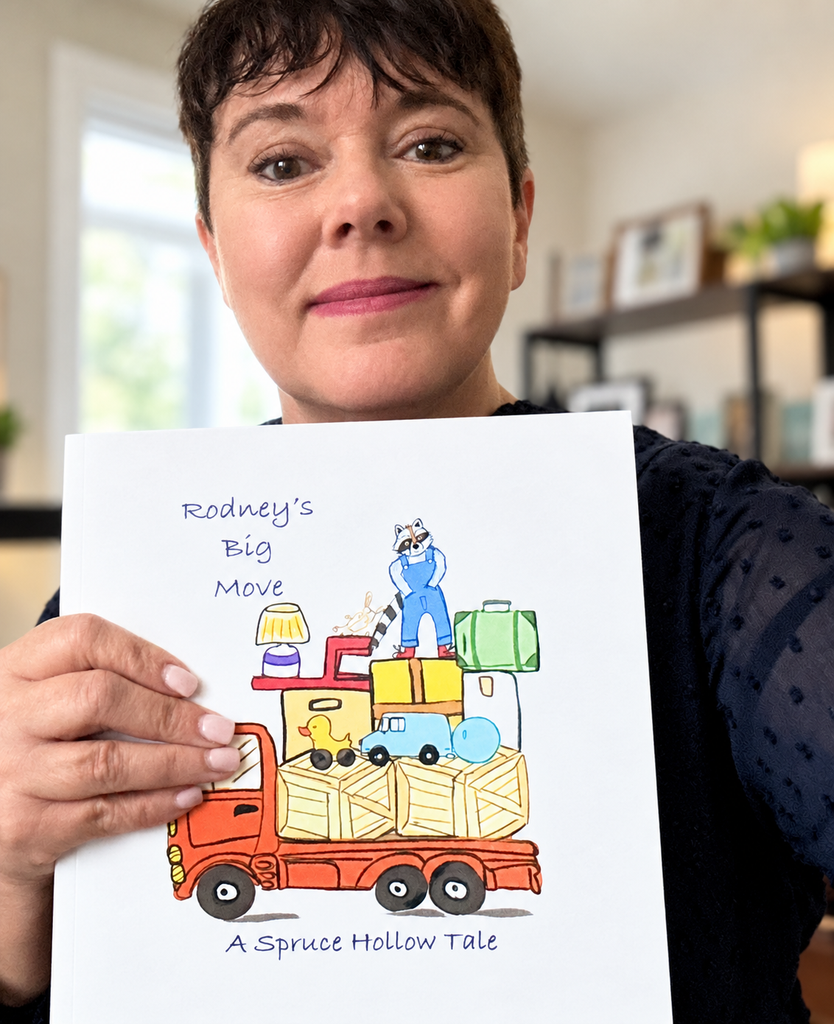
Cheryl Farnsworth is a reading instructor from New Hampshire. As a teacher working directly with children’s reading and literacy, she understood the need for engaging, approachable books that help young readers progress beyond the picture-book stage.
But Tales from the Spruce Hollow began with one particular child: Cheryl wrote the first story for her granddaughter.
She brought her own text and illustrations to BookBildr, assembled the book using the online editor and developed Spruce Hollow into a continuing children’s chapter-book series. The books were subsequently published with BookBildr, and Cheryl is now working on a new title.
Her professional experience allowed her to recognise a wider demand, but the series retained its personal beginning: a grandmother creating a story for her granddaughter and discovering that other children needed books like it too.
Her work also answers a question authors sometimes ask our support team directly: BookBildr is not limited to 24- or 32-page picture books.
You can use BookBildr to create a longer illustrated story, organise it into chapters and add as many pages as the book requires. Your illustrations may appear on every spread, at the beginning of each chapter or only at selected moments in the story. You decide how the text and pictures work together.
How to create a chapter book with BookBildr
You do not need professional page-layout software to begin. In BookBildr, you can:
- Create a new book project and choose its format.
- Add your own text to editable text boxes.
- Upload your illustrations and place them where the story needs them.
- Add, remove and rearrange pages as the book develops.
- Create a consistent design for chapter headings, page numbers and body text.
- Preview the complete book before ordering a printed copy.
You can construct the book yourself, as Cheryl did, or ask BookBildr for professional help with proofreading, layout, print preparation and publishing.
Before designing, think about the child who will read the book. How old are they? Are they reading independently or with an adult? How long can a chapter feel satisfying without becoming tiring? Where would an illustration help them understand the scene or simply make them eager to turn the page?
Do not reduce the font until a long manuscript fits into an arbitrary page count. A chapter book needs room to breathe. Readable type, sensible line lengths, clear chapter openings and well-positioned illustrations matter more than making the book as short or inexpensive to print as possible.
Books children can finish and want to keep reading
The answer to declining recreational reading is not to assume that children no longer want stories. It is to give them stories in forms they can enter confidently.
A well-designed chapter book can preserve what children love about picture books while opening the door to longer narratives. It offers visual interest without talking down to the reader, and genuine literary substance without confronting them with a wall of text.
Most importantly, it lets a child reach the final page and think: I finished that book. What happens next?
If you have a chapter-book manuscript, or the beginning of a series, you can bring your own text and illustrations to BookBildr and start building the book online.